Saturday, April 6, 2013

Rainbow Bridge by Land


Rainbow Bridge, often described as the world's highest natural bridge, was first publicized to the outside world in 1909. Before then it was known only to the local Indian Tribes, and probably a few white wanderers. It was proclaimed a National Monument by William Howard Taft in 1910. Teddy Roosevelt and Zane Grey were among the first to make the trip to the site from Navajo Mountain.1

The span of Rainbow Bridge was reported in 1974 by the Bureau of Reclamation to be 275 feet (84 m), but a laser measurement in 2007 showed a span of 234 feet (71 m). At the top it is 42 feet (13 m) thick and 33 feet (10 m) wide2

At first the best way to visit the bridge was by the long, arduous trip trip by foot and horseback from Navajo Mountain. With the popularity of river running after World war II, it was possible to float down the Colorado for several days and then hike some seven miles up-canyon to the bridge. Later, jet boats were used to travel upstream from Lees Ferry. After Glen Canyon Dam was completed in 1963 and the water rose in Lake Powell, access by motorboat became much easier and is now the main way to access Rainbow Bridge.3

A National Park Service document titled “Rainbow Bridge, Administrative History” describes how the arch was formed, the native people who lived nearby, the early European settlers and the development of the arch as a National Monument4

Several people in our group of hikers had long talked of visiting Rainbow Bridge by trail and we finally decided that we would hike in on the South Rainbow Trail (along the southwest side of Navajo Mountain) on 6 and 7 April and return by the North Rainbow Trail (along the north side of the mountain) on 8 and 9 April.
This is not just a pick-up-and-go hike, but requires some planning. First there is the matter of obtaining permits from the Navajo Nation. The hiking fee is $5 per person per day and the camping fee is an additional $5 per person per day. You will find that a back country permit is also required; however, that turns out to be no more than the receipt issued when you pay for the camping fee. We purchased our permits at the Navajo Parks and Recreation Department office at Cameron, a small hogan located at the intersection of US 89 and AZ 64.

Because we would be returning to the north trailhead and because we did not wish to leave our vehicles unattended while hiking, we arranged with a Mr. Julius Holiday to park our vehicles at his house and have him take us to the south trailhead and then pick us up at the north trailhead.

When the day finally arrived, we drove to Cameron and stopped for lunch. The below photograph was taken in front of the Cameron Post Office.

Left to right: Frank Lombardo, Mary Gavan (why's she hiding?), Becky 
Fowsky and Jim Manning – photograph by the author
After lunch we continued north on US 89A, turned east on US 160, drove through Tuba City, turned north on AZ 98 and then north on Indian Route 16. We called Julius along the way to let him know we were coming and he met us at the intersection of Indian route 16 and 161. From there, it was just a short distance to his house. We then parked our vehicles, climbed into his 4-wheel drive pickup and were off to the trailhead.

The National Park Service publishes a written trail guide giving distances and trail markers along the way. However, be aware that this guide starts measuring the distance about half a mile before the official trailhead. Apparently, this is because the last half-mile of road leading to the old Rainbow Lodge site where the trail actually starts is just too rough for even most 4-wheel drivers.

Rainbow Lodge was built by brothers S.I. and Hubert Richardson in 1923 to service tourists who wished to travel to Rainbow Bridge. According to their son, Michael, Barry Goldwater's wife purchased a half interest in the lodge for her husband while he was overseas during World War II.5 The lodge was largely destroyed by a fire in 1951, leaving only a recently-constructed stone garage to accommodate guest functions. Meanwhile, Glen Canyon Dam was completed and the much easier trip to Rainbow Bridge by way of Lake Powell made land travel to the site an uncompetitive endeavor. Also, Goldwater's interest had by then shifted to national politics and The Rainbow Bridge and Hotel company closed in 19656.”

Depending on what source we consulted, the hike into Rainbow Bridge would be between 13 and 16 miles, a long day's hike, so we elected to hike in a few miles before dark to give ourselves a head start on the next day. Julius dropped us off at the trailhead located at what remains of Rainbow Lodge, and we donned our packs and set out on the well-defined trail. Traveling along the juniper-covered slope of Navajo Mountain, we climbed into and out of First Canyon and entered Utah. Continuing on, we crossed Horse Canyon, another steep descent and ascent. It was now getting late in the day and we wanted to set up camp before dark, but knowing that we had another canyon to cross along the slope of the mountain, we pressed on to cross it and camp on its far rim. We were high on the southwestern slope of Navajo Mountain at an elevation of about 6200 feet and, after dark, had a grand view of the lights of Page, 2000 feet below us and some thirty miles away. I first thought that I was looking at Tuba City; however, the lights seemed too extensive. In retrospect and after referring to a map, I determined that we were seeing Page.

The next morning we ate breakfast and pressed on, wanting to get to Echo Camp at Rainbow Bridge at a decent hour. From our campsite it was about another three miles to Yabut Pass, a very narrow pass which affords a spectacular view down into Cliff Canyon on the other side. From this point, the trail descends rapidly into the canyon, falling about 1600 feet in around two miles. It then follows along the bottom of Cliff Canyon for about three miles to the junction with Canyon. A small sign is posted showing the way to Redbud Pass.

When the trail turns from Cliff Canyon into Redbud Canyon toward the pass it starts a gentle climb, rising about 100 feet in around three-tenths of a mile and then another 100 feet or so to ascend a plug in the canyon, apparently caused by an ancient collapse of the canyon walls. At the top of this plug is Redbud Pass. From the pass streamflow in the canyon is reversed, flowing back to Cliff Canyon on one side and down to Bridge canyon on the other. This is the route created by Charles L. Bernheimer7, guided by John Wetherill8 in 19229.

I was never absolutely sure that I saw exactly where the Bernheimer/Wetherill party had chiseled and blasted “a path wide enough to lead a horse through”10. We did find dates inscribed on the cliff wall in a very narrow section of the canyon below the pass. One of the inscriptions said 7-22 which does correspond with the date they completed their work.

We encountered one area between Redbud Pass and the intersection with Redbud Creek where a rockslide has partly blocked the canyon. We removed our packs and lowered them by rope over this section. This could actually have been accomplished without the rope as long as one were not hiking alone; it just required one person to hand the packs down and one at the bottom to receive them. But the rope was handy.

By this time, I was lagging far behind the rest of the group, but Jim and Frank took turns waiting for me. When we reached the conjunction of Redbud Canyon with Bridge Canyon, a little over two miles upstream from Rainbow Bridge, I saw a large cairn and knew that we had reached the juncture with the north trail, the route we intended to take for the return trip.

From this junction it is about 1.6 miles downstream to Echo Camp. One first passes through a gate and then, just when Rainbow Bridge comes into view, a side trail veers off to the right. This trail leads to the camp, located in a very pleasant alcove just below Echo Spring. We took the side trail and proceeded to make camp, leaving our visit to the bridge for the morrow.

We filtered water for the next day, ate dinner and settled into our tents for a good night's sleep. Unfortunately, a very strong wind began to blow and we were awake most of the night wondering whether our tents would blow away.
The next morning was cloudy, but still hopeful that we would not have rain, we hiked on down to the bridge for a closer look before starting our return journey.

The below map shows the the north/south trail junction, Echo Camp and Rainbow Monument.

Map showing Rainbow Bridge area
From Echo Camp, one just hikes up a small rise and down the other side to to enter the monument through a gate. The sign shown in the following photograph (see next page) identifies the boundary and provides guidance for visitors.

Sign at upstream entrance to Rainbow Bridge National Monument
On the cliff wall are mounted two plaques commemorating the two Paiute Indians (Jim Mike, AKA Mike's Boy and Nasja Begay) who guided the Cummings/Douglas party on their exploratory trip to Rainbow Bridge. I tried to photograph these plaques, but couldn't get a close enough shot to show the inscriptions. I did manage to make out the name “Jim Mike “ on one.

Some of our party followed the trail on under the bridge to look at it from the other side. As they returned, they encountered a sign telling them not to walk under the bridge. Apparently the five tribes involved with the bridge (Navajo, Hopi, San Juan Southern Paiute, Kaibab Paiute and White Mesa Paiute) find that religiously offensive without the offering of special prayers.

I managed to get the photograph I wanted from the upstream side of the bridge (below) and avoided offending any Indian gods.
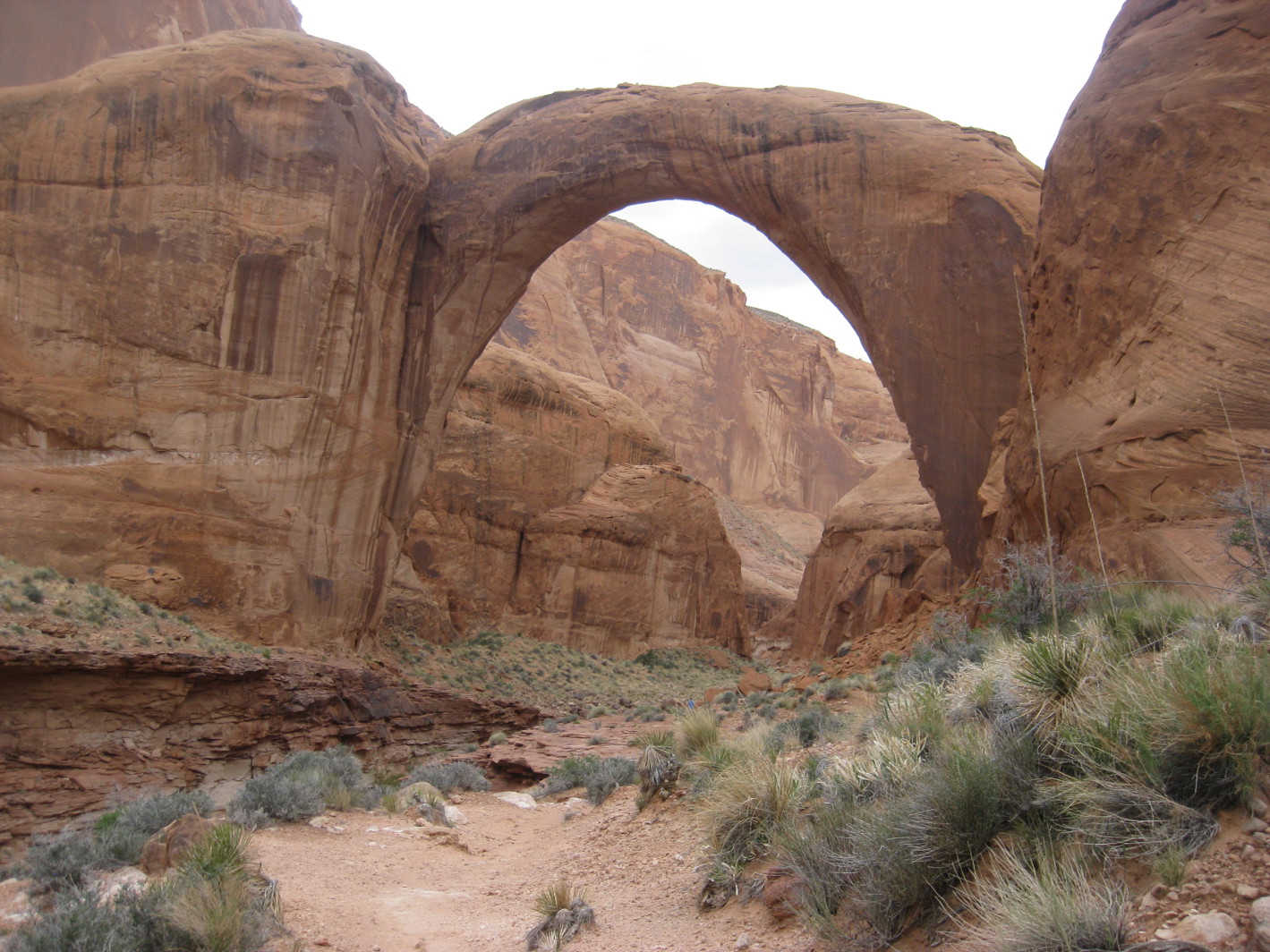
Rainbow Bridge
After examining the bridge, we made our way back up Bridge Canyon to the junction with the South Rainbow Bridge Trail at Redbud Canyon. From there we continued up Bridge Canyon, following the North Rainbow Bridge Trail.

The day was generally cloudy when we set out, the sun only occasionally breaking through, and then only for short periods. At first we climbed at a fairly gentle incline along Bridge Creek, heading generally southeast. Then we turned to the northeast to climb out of Bridge Canyon and descend into Oak Canyon around 2.8 miles ahead. Along the way, it started to rain in earnest and, having come to a large dry overhang with several dead limbs scattered about, we paused to take shelter and build a fire to dry out and warm ourselves.

We lingered in our dry spot by the fire for a considerable time before the rain stopped, temporarily, and we extinguished our fire and moved on.

However, it was soon raining again and we had intermittent bursts of snow, sleet and hail as we continued on our way. We stopped for the night a mile and a half short of our intended camping spot at N'asja in Surprise Valley. Our stop at the dry overhang had delayed us and it was nearing dark, so we found a relatively flat spot above a flowing stream and pitched our tents for the night, barely in time to avoid another cold shower. Not wanting to get wetter than I already was trying to cook a meal, I settled for the meager cold leftovers I had and climbed into my warm sleeping bag. Although the patter of rain on my tent awoke me several times during the night, I did get a good nights sleep. However, I was a bit late getting up the next morning and found the others ready to go before I had managed to eat breakfast. The rain was beginning again and I didn't want to try preparing breakfast in the rain, so I decided to make do by eating trail mix along the way.

The rain continued for most of the morning, occasionally mixed with snow flurries and, again, a bit of hail. I was falling behind again with Frank or Jim staying close by. I had trouble swallowing the trail mix that I had planned on using to sustain me during the day. I popped it into my mouth and chewed, but simply couldn't swallow it without taking a drink of water which was in rather short supply at this point.

We were now descending into and climbing out of canyons, similar to our experience on the South Rainbow Bridge Trail along the southwest slope of Navajo Mountain where we had ascended a total of 1500 feet to reach Yabut Pass and found ourselves at our starting elevation. I pushed myself very slowly up the canyon walls along the way. In the particularly difficult climb out of Bald Rock Canyon, Frank went ahead with his pack and returned to meet me and carry mine rather than wait for me to struggle to the top with it.

We found a clear stream that would not clog Frank's filter somewhere along the way and he filtered some water for me; this enabled me to swallow some trail mix which helped some.

Finally, about a mile from the trailhead, I looked up and saw Mary, followed by Jim, coming back down the trail to meet me. Having reached the end of the trail and finding Julius, provider of our trail head-to-trailhead transportation, waiting there, she and Jim had decided to return and take turns carrying my pack for the rest of the way. I did not argue. She and Jim had also scrounged a couple of power bars for me and I quickly gobbled them down with the rest of my water.

If I were ever to do this hike again, I would want to take two full days in and another two days back out. I would also wish for better weather.

The included map (below) shows the track of our hike. Because I lost satellite reception in many places, the track is a compilation of the actual GPS track and a track sketched from Google Earth using a USGS overlay. The green track shows the South Rainbow Bridge Trail from Rainbow Lodge to Echo Camp. The blue track shows the North Rainbow Bridge Trail from the junction of Redbud and Bridge Canyons to the north trailhead at Cha Canyon. The short yellow section is the trail from Echo Camp to Rainbow Bridge. Finally the Magenta-colored tracks are part of the 18-mile drive from the north to south trailheads.


1http://en.wikipedia.org/wiki/Rainbow_Bridge_National_Monument
2Ibid
3Ibid
5http://www.barrygoldwaterphotographs.com/html/0715_Road_to_Rainbow_bw.html
6http://www.nps.gov/history/history/online_books/rabr/adhi/adhi4a.htm
7Rainbow Bridge Circling Navajo Mountain and Explorations in the Bad Lands of Southern Utah and Northern Arizona
8http://wetherillfamily.com/john_wetherill.htm
9http://www.nps.gov/history/history/online_books/rabr/adhi/adhi4a.htm

10http://www.nps.gov/history/history/online_books/rabr/adhi/adhi4a.htm   

Saturday, March 30, 2013

Mescal Mountain Trail


Seventeen Skyliner hikers from Cottonwood and Sedona hiked Mescal Mountain Trail on 30 March 2013. We drove to the upper parking area for Long Canyon Trail on Long Canyon Road. From there we took the undesignated but well-worn connector trail across a dry wash and connected with Long Canyon Trail about 0.3 miles above the trailhead. We then followed Long Canyon for about 0.3 miles before turning west onto Mescal Mountain Trail (unsigned) at an old fence.

A short distance up this trail we came to what some call the “Birthing Cave,” supposedly used by Indian women for giving birth.

Hikers standing in front of the “Birthing Cave” alongside Mescal Mountain 
Trail
Having already seen the cave, I stayed on the trail below. I wonder whether Indian women went out of their way to give birth in such a place. It may well be just another story provided for tourist consumption.

As it headed up to a saddle in the mountain ahead, the trail became ever steeper and we found a couple of rock ledges that we had to literally crawl over.

On arriving at the first saddle we had a view across the Seven Canyons Resort to Wilson Mountain looming in the background. Note the distinctive red-rock sandstone base overlaid with cream-colored Coconino sandstone. The protruding cliff (left) of Mescal Mountain provides a closer view of the red sandstone.

Seven Canyons Resort and Wilson Mountain beyond
Looking to the northwest we could see bikers traveling along Deadman's Pass Trail which links Boynton Canyon Trail to Long Canyon Trail.

Mescal Mountain forms a ridge running generally northeast to southwest and has an adjoining ridge protruding to the southeast. As shown in the below photographs, our trail climbed from the first saddle, part way up the face of the southwest running ridge and then passed close alongside a sheer cliff wall leading to another saddle separating the mountain proper from the ridge running to the southeast.

Trail up the ridge from first saddle
Passing close alongside the cliff
From this saddle we could see Mescal Bike Trail running close along the side of the mountain to connect with Deadman's Pass Trail on the west side of the mountain.

We continued on across the saddle and climbed to the top of the southeast protruding ridge. From here we were able to see another section of the Mescal Bike Trail as it wound its way toward us from its trailhead at Long Canyon Road near the intersection with Dry Creek Road before veering to the west to join Deadman's Pass Trail.

We stopped for lunch at the top of the ridge. A gentle breeze was blowing and the sky, as it had been all day, was thinly overcast. It was not unpleasant but some of us did don our jackets.

Looking straight ahead from the ridge, we could see Dry Creek Road as it made its way back past Lizard Rock toward Sedona. In the below photograph, Lizard Rock is barely discernible at the top of the outcropping just to the left of the road. Thunder Mountain (the highest formation) looms starkly against the sky farther left. Two hikers are shown in the foreground carefully picking their way across the rocks.

Dry Creek Road, Lizard Rock and Thunder Mountain and two hikers
We paused for a group photograph before heading back.

Left to right (standing): David Beach, Jim Manning, Mark Purcell, Lila 
Wright, Beverly Sass, Becky Fowsky, Chris Adler, Marywave Van Deren, 
Miriam Sterling, Greg Mortimer, Gary Jacobson; (kneeling): the author, 
Dolly Yapp, Daisy Williams, Donna Goodman, Betty Wolters 
– photograph by unnamed using authors camera
The trip up had been considerably more difficult than I had anticipated and the trip back down, although faster, was also difficult. Not having hiked this trail before, I had relied on reports by others and I think they must have been much better hikers. Nevertheless, we did all make it back in good shape.

This hike was only 1.3 miles one way from where we parked. The highest elevation was 5026 feet and the total ascent was 528 feet.

Our GPS track is shown in red on the included map (below). The short blue section of track shows the section of Long Canyon Trail from the trailhead to where we entered the trail (Trl Jct) from the upper parking lot. From there to the spot marked “Trl Jct2,” our path is contiguous with Long Canyon Trail. The red flag shown midway along the blue track marks the spot where (according to the topographic map I am using) a branch of the Mescal Bike Trail intersects with Long Canyon Trail.


Saturday, March 23, 2013

Ryal Canyon Trail


Our hike for 23 March 2013, Ryal Canyon Trail 521, was new to us. Two members of the group had scouted it; however, neither was able to hike with us today. They did provide a description and I found a GPS track for the trail on the web.

The lower trailhead is located on Salt Mine Road 1.5 miles south of the junction of Salt Mine and Oasis Roads, When we reached the trailhead, the sun was shining brightly, but this was tempered by a chilly breeze that felt as though it were blowing across snow-covered mountains. The trailhead sign had been torn down, no doubt by some careless 4-wheeler, and was lying flat on the ground. Nevertheless it served to reassure us that we had reached our intended trail.

The trail at first leads across a flat and then up a gentle slope, but after about 0.3 miles it starts to rise steeply and, with a few short interruptions, continues at a steep slope for the rest of the way to its junction with Trail 521. We found that we were climbing along the crest of the north wall of Ryal Canyon. At one point the crest was only a few yards wide, with Ryal to the south and a small basin carved out by an intermittent stream between Ryal and Lucky Canyons to the north. After we passed the head of that intermittent stream, the canyon wall we were following clearly divided the two canyons. Beyond Lucky Canyon to our north we could see the far wall of Copper Canyon where I-17 snakes its way up the mountain.

We passed through two gates, one near the trailhead and another farther up the mountain. However, we saw no cattle, excepting a pile of bones near the second gate, and the metal watering tanks placed along the way were mostly dry.

The trail, obviously used fairly extensively by off-roaders, followed closely along a barbed-wire fence that ran up the spine of the ridge; the watering tanks, fed by a black plastic, above-ground waterline were placed so as to allow stock to water from both sides of the fence, about two-thirds of each tank protruding into the north pasture. Farther up the mountain, the trail left the fence and dipped down into Ryal Canyon and we did note one small tank that actually contained water. However, there were no signs of recent usage.

When I say the trail “dipped down” into the canyon, I do not mean that we were actually traveling down hill, rather that while still climbing rather steeply, we were getting closer to the stream in the bottom of the canyon. The trail continued to slope upward pretty much as shown in the below photograph which was taken on the way back down the trail.

Descending hikers carefully picking their way back down the trail along 
the north wall of Ryal Canyon
The trail did finally turn downhill, just 0.1 miles short of its end at Trail 511. On reaching the end of the trail, we continued about 50 yards along Trail 521 to the spring, labeled just as “Ryal Water” on my map, that feeds the stream running down the canyon.
It was about 1145 when we reached the spring and we scattered out to various sun-drenched spots that were sheltered from the wind and settle down for lunch. In my case, of course, followed by a short nap.

All too soon it was time to leave and I started the somewhat lengthy process of donning my gear. I was breaking in a new pack loaded with everything I would require for any of several upcoming backpack trips (Rainbow Bridge, Crack-in-Rock Indian Ruins on the Navajo Reservation and a 5-day trip down Paria Canyon) along with two 48-oz bottles of water hanging from my belt. With the extra 96 ozs of water, needed only for the Crack-in-Rock, I was carrying 42 lbs.

When everyone was ready, we stopped for a group photograph before starting the trip back down the mountain.

Left to right (crouching): Dolly Yapp and Donna Goodman; (standing): Jim 
Manning, Frank Lombardo, Gary Jacobson, Marywave Van Deren, the 
author, Anita Jackson, Daisy Williams and Miriam Sterling
– photograph by unnamed
The below photograph, taken just after we started back, shows the short section of the trail that leads up from the spring. Except for this 0.1-mile section, the trail back was essentially downhill all the way back to our cars.

Short uphill section of trail on the way back down the mountain from 
the spring in Ryal Canyon
Once we climbed up the rise shown in the above photograph and started downhill, the going was faster, but hiking downhill along a trail strewn with loose rock is hazardous and requires close attention to footing. Stepping on a rock that rolls can cause a serious fall, and this trail was composed of just such rocks. Note the care with which the descending hikers are placing their feet (photograph before group shot).

When we were able to take our eyes off our feet we had good views across Camp Verde spread out below and the tree-lined course of the Verde river snaking its way down the valley.

Looking out over Camp Verde and the Verde River in the valley below
We made it back to our cars without any serious falls and were much relieved to settle into soft seats.

The GPS track of our hike, from the lower trailhead to the spring in Ryal Canyon just beyond the upper trailhead, is shown in red on the included map (below).

The round-trip hiking distance was 5.2 miles, the maximum elevation was 4768 feet and the total ascent was 1703 feet.


Saturday, March 16, 2013

Bear Mountain Trail


On a sunny day with a high, thin layer of clouds providing some protection on an unseasonably warm late winter day, sixteen Skyliners hiked Bear Mountain Trail on 16 March 2013.

Thirteen hikers (Dave Beach, Miriam Sterling, Frank Lombardo, Collene Maktenieks, Anita Jackson, Dolly Yapp, Jim Manning, Donna Goodman, Daisy Williams, Betty Wolters, Lila Wright, one unnamed hiker and the author) gathered at Cottonwood and carpooled to the trailhead. From Cottonwood, we traveled north to Sedona on Hwy 89A and turned left onto Dry Creek Road. About 2 miles from Hwy 89A we passed Vultee Arch Road leading off to the right. After about another 0.85 miles (2.85 miles from Hwy 89A) we reached a stop sign. Long Canyon Road leads to the right from here. We turned left onto Boynton Pass Road, traveling another 0.6 miles to reach a second stop sign at the junction with Long Canyon road. Turning left we continued on Boynton Pass Road for about another 1.25 miles before turning into the trailhead parking lot for Doe Mountain and Bear Mountain Trails.

Three additional hikers (Becky Fowsky, Mary Gavan and a second unnamed hiker) were waiting for us there.

We crossed the road and found a graduate student ensconced in a camp chair at our trailhead. He was doing a paper on hiking in the wilderness. Apparently, the paper was trying to determine what hikers expectations were as they headed into the wilderness and whether those expectations had been met when they returned. Scholarly research on the benefits of wilderness areas seemed a good cause, and we stopped long enough to fill out a short questionnaire.

The trail leads generally headed northwest for its entire length. During the first quarter of a mile, crossing a mostly flat plain bisected by deep-cut gullies. It then continued up the slope of Bear Mountain, gently at first, but rapidly becoming quite steep and climbing 1000 feet in the next mile.

The photograph shown here (right), taken shortly after we started the climb up the steep mountain slope, shows the trail crossing the flat plain below to the parking area nestled at the base of doe Mountain.

After a hard climb we found ourselves nearing the top of the hematite-tinted sandstone (red rock) and the mountainside was littered with fallen cream-colored rock from the overlying layer. The following photograph shows hikers nearing the top of the red-rock formation.

Hikers nearing the top of the red-rock formation
When we were about a mile from the trailhead we could look southeast across a small canyon to beautiful red-rock formations on the other side and on across Sedona to Munds Mountain looming in the distance.

Red-rock formations across a small canyon and Munds Mountain looming 
in the distance beyond Sedona.
After topping the red-rock formation, the trail lead gently upward for a distance then started a steep climb once again. We were hiking along a ridge that, with intervening saddles followed by ever steeper climbs would lead us to the top of Bear Mountain which still loomed high above us.

Just over half way up the trail we topped a small summit of the ridgeline we were following and had our first glimpse of what lay on the other side of the mountain. In the following photograph, red sandstone spires arise from the bottom center pointing to Casner Mountain in the distance while the cream-colored shoulder of Bear Mountain intrudes from the right.

First view of the terrain beyond Bear Mountain
The trail was generally easy to follow with small cairns built by previous hikers placed along the way. There were occasional side paths leading off to viewpoints, but if one did take one of these in error, the mistake soon became apparent.

We became pretty scattered out on the way up the mountain, hiking in four different groups. One group decided to stop for lunch part way to the end of the trail and turn back from there. The other three groups went all the way to the “top” only to discover that it was just the end of the trail and that the highest point on Bear Mountain lay about a mile north and another 100 feet higher. No one seemed disposed to go another mile, closer to two along the course we would have had to take.

By the time I arrived at the trail's end, those who had arrived first were almost ready to start back. I ate a quick lunch and settled in for my customary nap, only to be awakened almost immediately by their departure. I reluctantly donned my pack and was on the trail shortly after they left. Betty was still with me, I think having been assigned as my keeper.

On the way back down, I stopped to photograph the Cockscomb formation and Doe Mountain from high up on Bear Mountain.

Cockscomb formation (center) and Doe Mountain just to its left
I certainly did miss that nap and was really dragging when we finally completed the hike. We had, according to my GPS hiked only 4.4 miles. However, the instrument gave our total ascent as 2037 feet. From the time we had left the plain that lies between the parking lot and the start of the climb, we climbed about 1000 feet per mile to reach the end of the trail. I don't mind climbing over 2000 feet, but I do like it to be spread out over a greater distance than two miles.

We found the graduate student still manning his post at the trailhead and paused for his follow-up questions.

After getting home and soaking in the tub for half an hour, I thought it a great hike.

Our GPS track is shown in red on the included map (below). The blue track is taken from a 2 February 2010 hike to an old still site in Fay Canyon.


Thursday, March 7, 2013

Chavez Historic Trail


Having located a wire-bound cairn marking the upper end of the Chavez Historic Trail during a recent hike to the Rattlesnake Canyon gaging station, we decided to do an exploratory hike in preparation for adding it to the regular Skyliner hike schedule.

It was a perfect day for hiking when five Skyliners (Jim Manning, Colleen Maktenieks, Miriam Sterling, Lila Wright and the author) set out on 6 March 2013. Anita Jackson had intended to join us, but her car had broken down.

Chavez Trail1, a road established in 1864 by Colonel J. Francisco Chaves, ran about 125 miles from Winslow (then Sunset Crossing) to Prescott (then Fort Whipple). It followed an old Hopi Indian path (the Palatkwapi Trail) that ran from the Colorado Plateau to Verde Valley. Upon reaching the Verde Valley, the trail continued by way of Montezuma Well to Camp Verde and then led up Copper Canyon to Ash Creek and on to Prescott. This would have it following the same route as the later established General Crook Trail2 (built 1872) from Camp Verde to Prescott. Chavez Trail itself served as part of a much longer road, running from Santa Fe to Los Angeles.

Although the Arizona State Parks website describes Chavez Trail as “relatively even and straight,” Martha Summerhayes3 described the portion of it that we were to hike (now know as Chavez Historic Trail) as follows:

Little by little we gave up hope of reaching Verde that day. At four o'clock we crossed the "divide," and clattered down a road so near the edge of a precipice that I was frightened beyond everything: my senses nearly left me. Down and around, this way and that, near the edge, then back again, swaying, swerving, pitching, the gravel clattering over the precipice, the six mules trotting their fastest, we reached the bottom and the driver pulled up his team. "Beaver Springs!" said he, impressively, loosening up the brakes.

As Jack lifted me out of the ambulance, I said: "Why didn't you tell me?" pointing back to the steep road. "Oh," said he, "I thought it was better for you not to know; people get scared about such things, when they know about them before hand."

"But," I remarked, "such a break-neck pace!" Then, to the driver, "Smith, how could you drive down that place at such a rate and frighten me so?"

"Had to, ma'am, or we'd a'gone over the edge."4

With this historical background in mind, we hikers drove north on I-17 from Verde Valley and took the Stoneman Lake Road exit. Passing back under the freeway, we turned as though to enter the freeway on the southbound ramp, but then immediately veered right onto a dirt road (Forest Road 647, though unsigned). About 0.3 miles from the I-17 exit, we came to a very rough section of the road where it crosses a wash. High clearance vehicles, even 4-wheel drive in wet weather, are highly desirable here. After crossing the wash we drove along a smooth, well-packed dirt road for another 0.5 miles before coming to a 90% right turn. We parked at the bend in the road and started our hike from there.

We knew that at least the trailhead was marked by a prominent cairn and we knew just where that was, just a few yards from our parking spot. We had no idea what sort of markings, if any, we might find farther along the trail. Examining the trailhead cairn (right), we discovered it had apparently been placed as part of a cooperative venture between the Forest Service and an organization named Back Country Horsemen of America.

We were pleased to find that we could also see another cairn within sight of the first, a pattern that was to be repeated all the way along the trail.

For the first three-tenths of a mile the trail led us southwest through a grove of junipers, but then turned and ran for half a mile to the northwest heading directly toward Rattlesnake Canyon. This shift in direction brought us around the head of Hog Canyon, after which we again turned southwest to travel along the spine of the ridge between Hog and Rattlesnake Canyons. At the high point of the ridge, about 2 miles from the trailhead, we paused for a rest. I was carrying about 40 pounds of weight including two half-gallons of water strapped to my belt, and just collapsed beside the trail for a good rest. The others walked on over to the rim of Rattlesnake Canyon for a good view up and down the canyon.

Continuing southwest along the rim of Rattlesnake Canyon, we came to its junction with Woods Canyon and passed around the head of Bias Canyon on our left. We were now traveling along the crest of the ridge between Bias and Woods Canyons. Soon we found that the trail was following very close to the rim of Woods Canyon and we had excellent views (see next three photographs) down into and across the canyon. Looking upstream, we could clearly see the junction with Rattlesnake Canyon; looking across the canyon and just slightly to the northwest we had a great view of Courthouse Butte with the smaller Bell Rock to its left. Meanwhile, looking northeast from our viewpoint, we could see Lees Mountain and Munds Mountain poking above Horse Mesa which formed the opposite wall of Woods Canyon.

Looking up Woods Canyon past the junction of Rattlesnake Canyon
Courthouse Butte (center); Bell Rock (left of Courthouse Butte)
Lee and Munds Mountains looming above Horse Mesa
We had expected the trail to be rocky. However, it had to this point been exceptionally smooth and easy to hike, and it continued to be so for another for another 2.5 miles or so as it dropped at a gentle slope, falling just 200 feet in that distance. After that, it became rockier and ever steeper, finally plunging 800 feet in 1.5 miles near the end.

I thought of Martha Summerhayes' words as we made our way down the steeper parts of the trail, now clearly following an old road bed that twisted its way rapidly downhill very close to the edge. In some sections it was steep enough that we had to take great care to avoid slipping on the loose gravel and falling. Having driven a few loaded mule-drawn wagons down steep slopes in east Tennessee during my youth, I could easily understand the teamsters response to Mrs. Summerhayes complaint about his speed.

As we neared the end of the trail we came out on Forest Road 9402T and followed it a very short distance to the car we had parked here to take us back to the upper end of the trail.
Later reference to an old topographic map placed the site of the stage station about half a mile south of where we came out. I don't know whether that is correct; however, we could find no signs of any old buildings where we came out, so I think I will add an investigation of the area shown on the map when we do a Skyliner hike on the trail.

On the included map (below) our GPS track is shown in red while the green line shows the route from the I-17/Stoneman Lake Exit to the upper trailhead.

As measured by my GPS track the trail is 8.6 miles long (one way), the maximum elevation is 5301 feet and the total ascent is 1706 feet.


Saturday, March 2, 2013

General Crook Trail South of Hwy 169


We left Cottonwood on 2 March 2013 intent on hiking the short section of General Crook Trail from Hwy 169 to Hecla (Ash Creek Station). Unfortunately, the Forest Service had closed off that section of trail at Hwy 169 for a controlled burn.

Undeterred, we simply walked across the highway and took the same trail in the opposite direction. None of us had been on this section of the trail before, but we found it relatively easy to follow with cairns located at frequent intervals. The sun was shining and a cool breeze was blowing, so we moved along at a good pace, crossing South Old Cherry Road in Hackberry Wash and then stopping atop the next ridge for a snack break and to take a group photograph.

Left to right (kneeling): Daisy Williams, Dolly Yapp, Colleen Maktenieks; 
(standing): Carey Torgl, Gary Githens, Donna Goodman, Miriam Sterling, 
Lila Wright, Anita Jackson and Jim Manning – photograph by the author
After our snack break we continued east along the trail until we were on top of a hill just west of the Gray Wolf Landfill and stopped there for lunch. We had now hiked about 3.6 miles, winding our way up and down gently-sloping, brush-covered hills along the old General George Crook Wagon Trail that once ran all the way to Fort Apache.

Following lunch, four hikers, including the author, decided to continue along the trail to the Hwy 169 crossing near I-17. The others would retrace their steps to our vehicles and pick us up at the crossing.

As we approached the landfill, we could see that it lay astride our path and that the trail would have to detour around it. As we came closer we found that a strip of private land lay to our left, between our path and Hwy 169. Eventually we found ourselves at the west boundary of the landfill where it extends south along Racetrack Wash. The entire property is fenced and No Trespassing signs are prominently displayed at frequent intervals. To bypass it we skirted closely along the fence, our way made easier by the cowpaths that also followed along the fence. In retrospect, we should have followed approximately along the blue line shown in the below figure. The faint dotted line at top of the figure shows the original trail, now closed by the landfill. The heavy red line shows our path and the blue line is a suggested short-cut for future hikes.

Bypass around Gray Wolf Landfill
When we came to the southeast corner of the landfill property, rather than following the fenceline directly north, we headed in a northeast direction to travel through a gap in the ridge caused by Johnson Wash. As we hiked up the wash, we noted a hawk circling around a rocky outcropping to our left. We also saw part of an old rock wall that must be part of an Indian Ruin. The wall is visible running along the very top of the outcropping in the below photograph.

Rock outcropping containing Indian Ruins
We were sorely tempted to climb up for a look at the ruins, but were constrained by fear of being late for our arranged pickup. So marking the ruins for investigation at another time, we continued on up the wash, eventually crossing over and climbing a gentle slope to rejoin the old General Crook Trail. Now we once again found rock cairns, absent during the detour around the landfill, strategically placed to guide us on our way. Additionally, the path of the old road was clearly visible for most of the way.

About 0.6 miles after rejoining the trail we came to an area where Crook Trail ran just a few yards south of Hwy 169, and Forest Road 9604F crossed the trail and connected with the main road. There was a good wide spot for parking and cellphone contact with the main group confirmed that they were almost back to the cars. We were still around 1.6 miles from our intended destination and wouldn't be able to hike that far by the time they arrived, so we arranged to wait where we were for pickup.

We had hiked about 6.3 miles at elevations varying from around 4315 feet to 4540 feet.

What Prescott National Forest identifies as General Crook Trail, an 11.3 mile stretch running from FR 323 at Ash Creek to FR 136 near the head of Copper Canyon, is part of the road established by General George Crook that ran from Fort Whipple to Fort Apache. Note that some descriptions of the trail have it starting at Fort Verde; however, since Fort Whipple was the regional headquarters, it must have started there.

While hiking along the section of the old road we were following this day, we wondered how far it would be if we were to follow the route all the way to Camp Verde. To answer that question, I first reviewed a previous hike from the firing range on FR 136 just off Salt Mine Road at Camp Verde to the old stage station in Copper Canyon and found that distance to be 4.7 miles. I then measured the distance along Crook Trail from where we stopped our hike to FR 136 and on down Copper Canyon to the old stage station and found that to be 5.3 miles. Thus we would have had to hike about another 10 miles to reach the junction of Salt Mine Road and FR 136 at Camp Verde.

Today's hike is shown in red on page 1 of the included map (below). Page 2 shows Crook Trail from FR 323 to FR 136 and on to the firing range at Salt Mine Road and FR 136 at Camp Verde.